
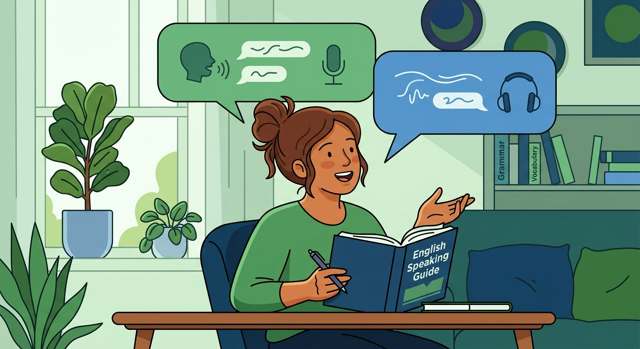
Do you understand English well but freeze the moment it’s time to speak? You’re not alone—speaking is the skill most learners struggle with. The great news is that you can learn how to improve spoken English right at home, with no classroom, no tutor, and no pressure. 🗣️
Fluency doesn’t come from one big effort. It comes from small, consistent daily habits that train your brain and mouth to produce English automatically. In this guide you’ll get 10 simple habits to improve spoken English at home, a realistic weekly practice plan, the mistakes to avoid, and answers to the questions learners ask most.
Why Speaking English Feels So Hard (and Why That’s Normal)
Speaking is difficult because it happens in real time. There’s no chance to pause, look up a word, or rewrite your sentence the way you can with writing. On top of that, most learners get plenty of input (reading and listening) but very little output (actually speaking). Your brain becomes great at understanding English and weak at producing it.
The fix is simple: deliberately rebalance your practice toward speaking. Every habit below is designed to give you more speaking reps, even when you’re completely alone.
10 Simple Habits to Improve Spoken English at Home
1. Talk to Yourself Out Loud Daily
Narrate your day as you go: “I’m making tea, then I’ll check my email.” It feels strange at first, but it builds speaking confidence with zero social pressure—and you can do it any time.
2. Think in English
Replace your inner monologue with English. When you catch yourself planning your day in your native language, switch it to English. This trains your brain to skip the slow translation step that causes hesitation.
3. Shadow Native Speakers
Play a short clip—a video, podcast, or song—and repeat each line immediately after the speaker, copying their rhythm, tone, and pronunciation. This technique, called “shadowing,” is the single fastest way to sound more natural.
4. Learn Phrases, Not Just Words
Native speakers think in chunks, not individual words. Memorise ready-made phrases like “Could you help me with…?” or “I was wondering if…” so they come out automatically in real conversations.
5. Record Yourself Speaking
Use your phone to record a one-minute answer to a simple question, then listen back. It’s uncomfortable at first, but hearing yourself reveals exactly which sounds and words to work on—and shows your progress over time.
6. Watch Shows and Slowly Drop the Subtitles
Start with subtitles in English (not your native language), then rewatch favourite scenes with subtitles off. You’ll train your ear to catch the natural, fast flow of real speech.
7. Find a Speaking Partner or Language Exchange
Conversation is the ultimate practice. Use free language-exchange apps to talk with real people, or join an online speaking group. Even one short conversation a week makes a big difference.
8. Don’t Fear Mistakes
Mistakes are how you learn—not evidence that you’re failing. Every fluent speaker got there by speaking through thousands of errors. Aim to be understood, not to be perfect.
9. Read Aloud Every Day
Reading articles, stories, or even social-media captions aloud improves your pronunciation, builds speaking stamina, and gets your mouth used to English sounds and sentence patterns.
10. Be Consistent
Fifteen focused minutes every day beats a single three-hour session once a week. Consistency is the real secret to fluency—small daily reps compound into big results.
A Simple 7-Day Spoken English Practice Plan
Not sure how to combine these habits? Here’s a light, realistic week you can repeat. Each day is just 15–20 minutes.
| Day | Focus | What to do (15–20 min) |
|---|---|---|
| Monday | Self-talk | Narrate your morning routine out loud in English. |
| Tuesday | Shadowing | Shadow one 3-minute video, line by line. |
| Wednesday | Phrases | Learn 5 useful phrases; use each in a spoken sentence. |
| Thursday | Recording | Record a 1-minute answer; listen back and note 2 fixes. |
| Friday | Reading aloud | Read an article aloud for 10 minutes. |
| Saturday | Conversation | Have one short chat on a language-exchange app. |
| Sunday | Review | Rewatch a show with subtitles off; relax and enjoy. |
Common Mistakes to Avoid
- Waiting to feel “ready” — start speaking now, imperfectly. Readiness comes from speaking, not before it.
- Focusing only on grammar — communication matters more than perfection. Grammar improves naturally with use.
- Comparing yourself to native speakers — compare yourself to who you were last month instead.
- Practising silently — if your mouth isn’t moving, it isn’t speaking practice. Always go out loud.
- Giving up too early — fluency is a marathon. The learners who win are simply the ones who don’t quit.
Put Your English to Work
Strong spoken English opens real doors—in study, interviews, work, and online income. When you’re ready to use your skills, two of our guides pair perfectly with this one: turn confident communication into earnings with our beginner’s guide to freelancing in 2026, and make a great first impression on paper with how to write a CV that gets you interviews. You can even speed up your learning with free tools—see our roundup of free AI tools every student should be using, several of which can act as a tireless speaking partner.
Frequently Asked Questions
How long does it take to speak English fluently?
With daily practice, many learners notice clear improvement in 3–6 months and reach comfortable conversational fluency in about a year. Consistency matters far more than intensity—15 minutes a day beats occasional marathon sessions.
Can I improve my spoken English without a partner?
Absolutely. Talking to yourself, shadowing, recording yourself, and reading aloud are powerful solo techniques you can do anytime. A speaking partner helps, but it isn’t required to make strong progress.
What is the fastest way to improve pronunciation?
Shadowing native speakers—listening and immediately repeating while copying their rhythm and intonation—is the fastest way to sound natural. Recording yourself and comparing helps you correct specific sounds.
How can I stop translating in my head when I speak?
Practise thinking in English during everyday moments and learn whole phrases instead of single words. The more ready-made chunks you have, the less you need to translate word by word.
Does watching movies really help me speak better?
Yes—especially when you shadow the dialogue and gradually remove subtitles. Passive watching alone helps your listening; combining it with repeating lines out loud is what improves your speaking.
Final Thoughts: Just Start Speaking
You already know more English than you think. The key is to use it out loud, every single day. Pick three habits from this list, follow the 7-day plan, and start today—your confidence will grow faster than you expect.
Keep practising and keep learning with Fun Education TV! 💪